Are Dating Apps Endangering Their Users?
By Maia Yunker

Jay Kobayashi
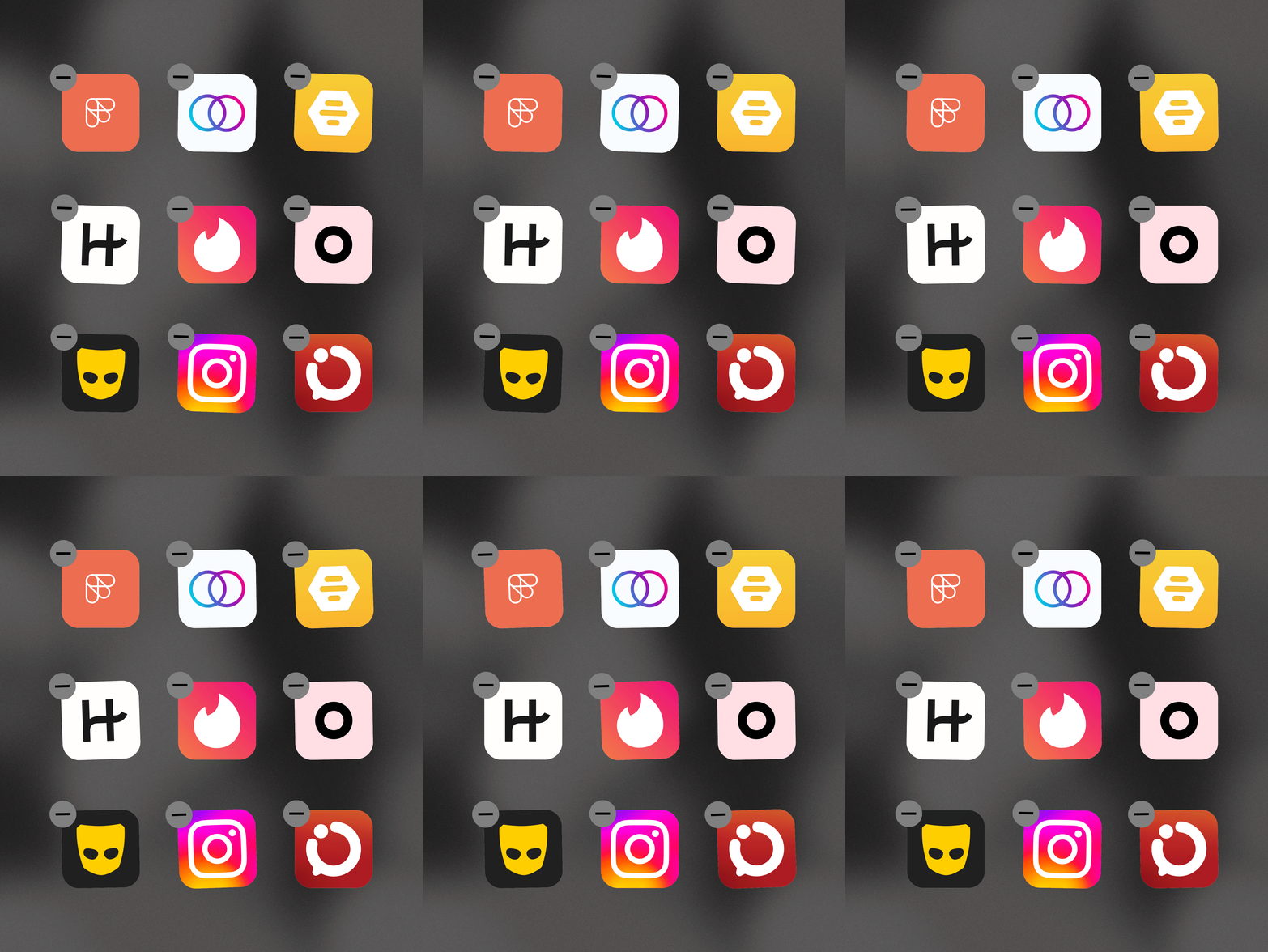
Meeting people in person has become exponentially harder in the modern age with the wide-spread use of online messaging, and more specifically online dating. Some say electronic meetups are a good addition to society, providing a more straightforward path to meeting individuals with the same ideals as you, while others say it is a danger that opens potential harm to society. Where new innovations arise, new problems and dangers will emerge with it; so, is using dating apps an inherently harmless activity that allows for an easy way to find a partner but in turn comes with some risks, or is it a reckless decision that could cost you a lot more than an unsuccessful date? The use of apps like Tinder and Hinge for the hopes of finding a significant other has been semi controversial for practically the entire time these apps have been open to the public. Supporters of these apps tend to argue that they provide an easy and fast way to find potential individuals that they would want to go out with in a casual more non-committal way. It is easy to skip over individuals that you are not interested in, and fast to message those who you are. You can also clearly see what the other person is looking for in a partner, and what their desires are for a relationship, which makes it easier right off the bat to know what you are walking into and if you would be compatible. Opposers of dating apps bring up the dangers that come with not seeing the person face-to-face and instead trusting an online profile to gain some sort of understanding of the person you are meeting up with. The apps have age constraints but no real way of checking to make sure the users are not lying, and this could be a real concern in terms of trafficking and minors slipping through the cracks. There are several legitimate points made by both sides of the discussion regarding dating apps that should be given thought and for the public to try and come up with a solution that could resolve the main concerns of the opposers and fulfill the desires of the supporters of the apps. Technology is here to stay so it is important to be educated and discern what is the best and safest decision for you.
Perspective 1: Dating Apps are Useful
Image by Sarah Rogers
 Dating apps allow for much more clarity right away and creates a more honest and open understanding of what everyone is looking for in a relationship and eliminates a large majority of misunderstandings or complications later in the relationship. Smith also brings up the point that by having the option of screening individuals online through messaging and their profile, you can create a safer experience for yourself because you have an idea of who you are meeting up with, Smith states; “. . .the immediacy of the apps provides the possibility of safer meetups: (Smith). Even though being able to investigate someone online before physically meeting up with them is not a 100% insurance that they are a safe person, it does give you one more barrier and opportunity to scout out and decipher if this specific individual seems genuine. Some dating apps also give you the option of sharing date details with a trusted individual, so someone else knows your plans, where you will be, and with who (Smith). Dating apps allow for a more streamline and time efficient way to meet someone, when you may not have the time or ability to traditionally meet and get to know someone organically. These apps can be a very useful tool, and something that if used right can be extremely beneficial to its users. Many individuals find that dating apps are extremely helpful in finding a possible significant other, specifically if the individual has a particularly busy life. In Heidi Smith’s article “Dating Apps Are Good, Actually”, she discusses how her experience with a dating app was positive and encouraged her to seek out a relationship during her busy days at university. Smith explains how being able to set expectations for the relationship narrows down the pool of possible partners right off the bat; “Your profile can display what type of relationship you’re looking for and you can discuss specifics before agreeing to meet up” (Smith).
Perspective 2: Dating Apps are Dangerous
A large majority of the population have a differing opinion, and this is that dating apps are inherently dangerous to the public and prone to misuse. While others argue that dating apps create safeguards like age restrictions, there is no reinforcement or verification that individuals are not lying about their age to participate in these apps. Emma S published an article on the site The Exodus Road to warn users of possible dangers lurking in dating apps; regarding the claim of lying about the age of users she states, “None of these apps required more than a birthday or phone number during the verification process, and we could easily use the app’s full functionality with false information” (Emma). There is no doubt that human trafficking has gone up significantly in the last several decades, but could dating apps be a contributor to this rise? If lying about personal details is so easy to get away with, it gets increasingly harder as a user to desirer if someone is telling the truth or not; the only way to make sure is to meet them face-to-face, but by then it could be too late. Another safety aspect of dating apps is that some allow you to share details about your meet ups to close friends; this could include time, date, and place of your activity (Emma). This is not a fool proof plan, however. Not all dating apps have this feature, and even when they do there is no guarantee that individual would be able to help or rescue you if something went wrong on the date. Dating apps allow for someone to create a persona and image before ever actually talking with you. Although on the surface this transparency could seem welcoming and safe, if you think about it, this is a perfect breeding ground for those wanting to take advantage of others; and dating apps gives them a perfect platform to perform these actions (Emma). With minimal regulations, and causal meet ups where expectations are set as to what the other is like, the chance of the person being different than what they let on in becoming increasingly more of a possibility.
Ben Siero and Ella Witchell
Similarities:
There are not an overwhelming number of similarities within these 2 arguments. One that is apparent, however, is that both opinions want the public to be safe. Neither party wants to put anyone in a dangerous situation, and this they can agree upon. One aspect that Smith brings up is that because interaction begin online, it is as easy as blocking that person if problems arise in any encounters. Smith states in her article, “Furthermore, if the other person is being particularly disrespectful, you can block them” (Smith). Emma gives advice on how to identify unsafe patterns and actions of someone with potential alternative motives. Some of these include love bombing, Emma explains it as, “. . .when an individual becomes extravagantly expressive of love very quickly” (Emma). She also gives the advice of not sending explicit photos, do research on the person, and trust your instincts (Emma). Both Emma and Smith mention ways for dating app users to stay safe within the apps themselves, and safety precautions to take when meeting up with potential partners from the app; this is how the two articles are the most similar.
Differences:
There are many more differences between the two opinions though. One such difference is that Smith believes that dating apps, if used responsibly, does not pose a strong threat to the safety of the users. Emma disagrees with this statement by explaining that there are not enough safeguards behind these apps, and this largely increases the danger of being taken advantage of. Emma states in her article, “Through the process of online dating, many people reveal personal information about themselves, which traffickers can use as vulnerabilities for manipulation” (Emma). Emma argues that dating apps are dangerous but can be used in a safer manner, “Dating sites offer an anonymous profile and the opportunity for abusers to manipulate targets through faceless messages on these new domain. . .it is crucial to make sure you know how to be safe when using them” (Emma). While Smith argues that dating apps are useful and beneficial but can be used in an unsafe manner, “. . .relationships initiated online – sometimes, boundaries can be violated. . .Establishing expectations often makes the experience more enjoyable and less stressful” (Smith). Emma and Smith’s arguments are written in opposite orders; one saying that the apps are mostly good with some bad, and the other saying the apps are mostly bad but can be used for good.
Strengths and Weaknesses:
Both arguments have several strengths and weaknesses. I will start by analysing Smith’s argument that dating apps are beneficial. Strengths to this argument could be that dating apps do supply an easy and fast way for busy individuals to find potential romantic partners. Smith says, “Your profile can display what type of relationship you’re looking for and you can discuss specifics before agreeing to meet up” (Smith). Because you can set up expectations and personal preferences beforehand it diminishes the time spent trying to figure out what each party wants in the relationship. Another strength that Smith brings up is that dating apps can be specifically helpful for those with busy schedules, especially college students. Smith states, “While dating apps are generally a positive took for the broader population, they are especially handy on a university’s campus” (Smith). One weakness in Smith’s argument though is that it is incredibly easy to lie online and make it believable nowadays. This is a real concern when meeting someone online and then meeting in person, you don’t truly know who you are meeting. Smith mentions the fact that “. . .it’s great to meet people organically – except when it isn’t, and your safety is threatened. The same is true of relationships initiated online. . .” (Smith). Emma’s argument against dating apps follows this theme and expands on it. A strength of her argument is that you cannot guarantee safety when meeting someone you haven’t seen in person before. It is extremely easy be put into an unsafe situation and as Emma states, “While certain apps require a birthdate, which the user can easily manipulate, making these websites accessible to those who shouldn’t be there in the first place” (Emma). What Emma is stating here is that your safety can be in jeopardy because of how easy it is to lie on these apps. There is a barrier that exists when communicating through a screen and it is easy to fake being someone you’re not, even if it is unintentional. One weakness of Emma’s argument, however, is that you can put measures in place to make meet ups safer. Emma brings up suggestions in her article, “There are many apps available. . .that allow you to send out emergency messages to law enforcement, trusted friends, and family if you experience anything unsafe” (Emma). You could also bring a friend with you for a double date or send details of the date to a friend; you could even share your location with a trusted individual so they can know your exact location.
Compromise:

Image by Shutter stock
It is naïve to think we can eliminate dating apps from society, but I don’t think we should allow these apps to expand so far that they are not controlled or regulated. Both Smith’s and Emma’s articles bring up good points on each end of the argument, and I believe that we can find a solution that satisfies both parties. Emma’s most prominent concern regarding dating apps is the possibility of being trafficked or taken advantage of. Although Emma does not mention catfishing in her article, this is a more common occurrence in the realm of dating apps but poses less physical danger to the partaking individuals. Emma’s concern of trafficking is targeted specifically towards women. There is no easy solution to this problem, however, one way you could try and reduce this risk is more through screening for the app’s participants. I also think adding more reliable age restrictions would help prevent younger individuals from slipping through the cracks and being put in dangerous situations. This would allow those who want to participate in dating apps, and are of proper age, to have a safer experience, while keeping underage individuals safe and away from those with bad intentions. Smith’s article explains that dating apps allow those with busy schedules a way to meet others with like-minded intentions, and I agree that dating apps shouldn’t be taken away completely. I think that by cracking down on regulations about who can participate on the apps we would keep the convenience of meeting others online, while decreasing the risk of creeps preying on vulnerable individuals. I do not believe there is a way to one hundred percent guarantee that people will not find a way to lie on the apps or cheat the system, but I do believe that now dating apps do not have strict enough rules and carelessly lets whoever participate without batting an eye. Ways women can increase their safety if using these apps is to communicate all plans with a trusted third party and have exit plans in place if the date feels off in any way. I think a compromise of increasing restrictions on the apps, while still making them assessable to the public is the best option and would satisfy most individuals on both sides, whether you are for or against dating apps.
Works Cited
Piña, Gillian. “The Dangers of Online Dating.” The Exodus Road, 30 Apr. 2024, theexodusroad.com/the-dangers-of-online-dating/.
Smith, Heidi. “Dating Apps Are Good, Actually - the Duke Chronicle.” The Chronicle , 24 Mar. 2024, dukechronicle.com/article/032524-smith-dating-apps-good-20240325.
Maia, you have such an interesting topic. I enjoyed reading your article, I think it was well structures. I also liked the two different point of views that you included to understand both sides better. Good Job!
ReplyDeleteYou did a perfect job explaining both the strengths and weaknesses of both arguments. The quotes were also interesting and supported each point well. Great job!
ReplyDelete